
Grade every role. Build every band. Defend every decision, to your people, your auditors, and your regulators. Vareqa is how your organisation structures, explains, and stands behind the way it pays.
Every role has a value. The question is whether you can explain how you arrived at it. REF™ is eight compensable factors with published point values, 1,000 maximum points, and twenty grade levels from Foundation to Group Board. It is rigorous enough to withstand a regulator's scrutiny, and simple enough that the employee in question can follow it.
Most organisations already have the raw material: role descriptions, internal job titles, existing salaries, some sense of where people sit relative to each other. What they lack is a consistent framework that turns that raw material into a defensible structure. Vareqa provides that framework, with an AI-assisted workflow that makes the evaluation practical at the scale real organisations operate at.
The output is a complete job architecture with defensible grades from R-01 to R-20, documented factor-level rationale for every role, pay bands linked to those grades, and compliance outputs ready to share with employees, auditors, or regulators. The methodology is published in full. If someone asks how a grade was reached, you can show them.
A pay architecture is only useful if it holds up when someone questions it. Vareqa is designed around four layers that reinforce one another, so the same methodology answers the employee asking about their grade, the General Counsel reviewing for litigation risk, and the regulator examining how you evaluate work.
Every pay transparency regime places specific obligations on employers. Vareqa maps to them directly: Article 4 of the EU Pay Transparency Directive is satisfied by the REF™ methodology. Article 5 by the Pay Band Builder. Article 7 by the right-to-information report. Article 9 by the Pay Gap Calculator. Article 10 by the Joint Pay Assessment workflow.
The same architecture extends to GCC nationalisation obligations, US state disclosure laws, Japan's EEOA, and UK reporting. Fifteen jurisdictions, 37 legal obligations, each mapped to specific platform outputs.
Every role evaluated in Vareqa produces structured data: role description, REF™ grade, pay band, geography, industry, headcount. Because all of it comes out of the same methodology, the resulting dataset is consistent in a way that self-reported salary surveys can never be.
As the customer base grows, this supports a benchmark layer that sits on top of the platform: an anonymised view of how comparable roles grade and pay across Vareqa customers. In development for a future release, subject to GDPR and competition law review.
No pay architecture should rest only on the vendor's word for it. To make REF™ independently reviewable, three forms of external validation are in development:
You grade the organisation once, but the obligations that follow are continuous. Ranges get published on every new job advert, employee information requests arrive with 60-day deadlines, annual pay gap analyses come around every year, and new roles need grading as the organisation grows. Treating compliance as a project rather than an operating state is why most organisations end up scrambling.
Vareqa sits underneath this as the system of record: where your grades live, where bands get updated, where responses are generated, and where the full version history is preserved. Any report your organisation has ever issued through Vareqa is traceable back to the methodology, and to the specific evaluation, that produced it.
The EU Directive is the most explicit example of regulatory mapping, because each Article defines a concrete employer obligation. The same approach applies to every jurisdiction Vareqa supports.
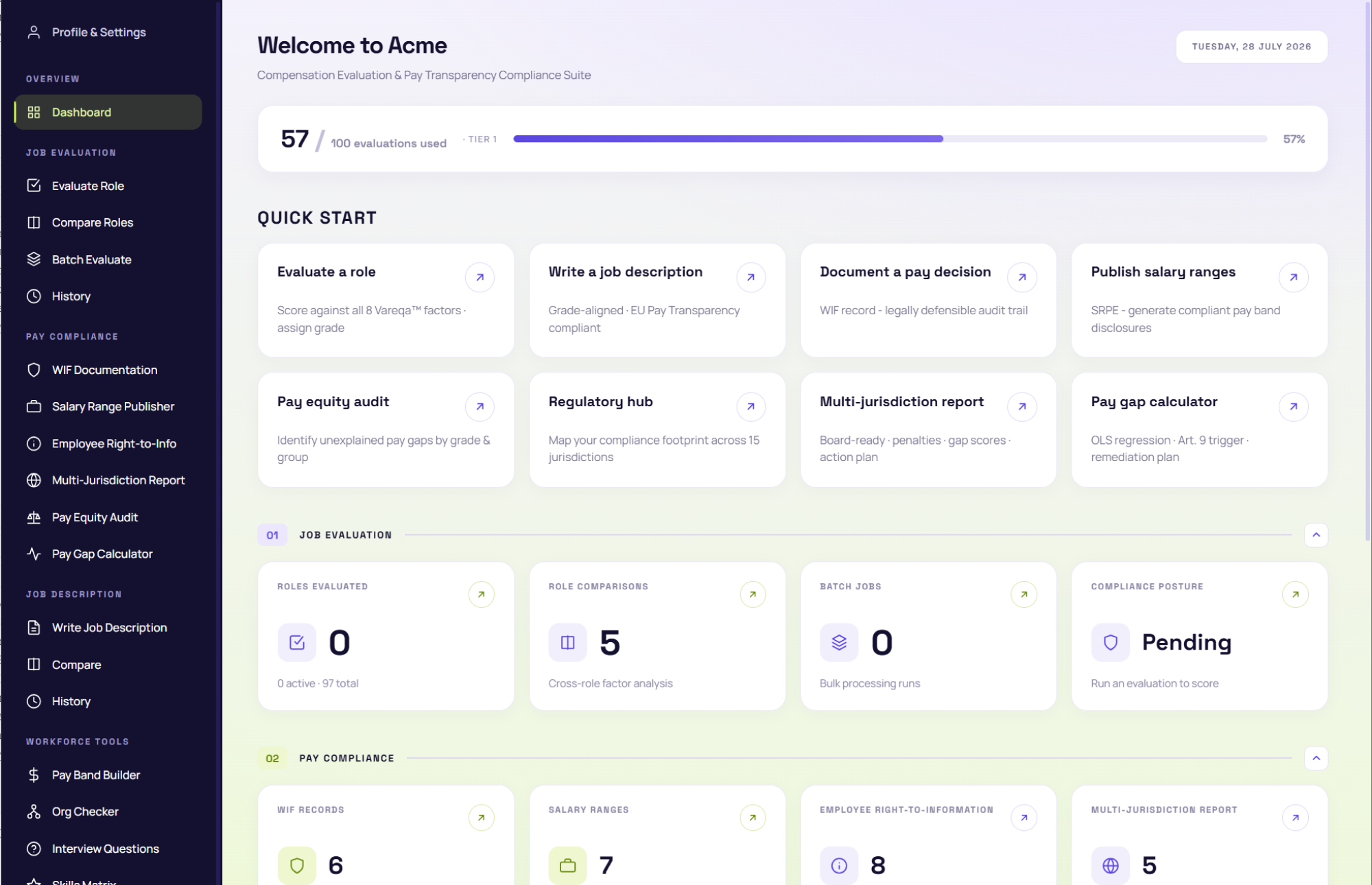
Every module in Vareqa shares a single data layer. Evaluate a role once and the pay bands, job descriptions, employee reports, and equity analyses are all built from the same foundation. Change a grade and everything updates together. This is what a pay architecture looks like when it is built as a system, not a collection of tools.
Employees in the EU now have a legal right to know their grade criteria, their pay range, and how their pay compares to colleagues doing comparable work. The Directive gives organisations 60 days to respond. That is a short window when you are starting from scratch.
Vareqa generates the response in minutes. A personalised, plain-language report in the employee's own language, covering everything the Directive requires and anchored to a methodology they can actually examine. Not a standard letter. A real answer.
Answering clearly builds trust and reduces disputes. Answering poorly, or not at all, creates claims, tribunal exposure, and a compliance record you would rather not have. The difference is whether you built the infrastructure to answer properly, or whether you are trying to improvise one under pressure.
Whether your people are in Frankfurt, Dublin, New York, Dubai, or Tokyo, Vareqa gives you a single defensible architecture that travels with your organisation.
Organisations operating across multiple jurisdictions carry unnecessary legal and operational risk when they maintain different grade structures per country or region. Vareqa provides a single, consistent architecture that works whether your people are in the EU, UK, GCC, US, or Asia Pacific, with jurisdiction-specific outputs where needed.
AI in Vareqa is a tool for speed and consistency, not a replacement for professional judgement. Every evaluation is reviewed and confirmed by a qualified practitioner. The AI suggestion and the practitioner decision are both recorded.
Pay transparency legislation is active or imminent across every major employment jurisdiction. The EU Directive, GCC nationalisation programmes, US state disclosure laws, Japan's EEOA, UK reporting, and Australia's WGEA are all heading in the same direction. One defensible pay architecture handles all of it, with jurisdiction-specific outputs where the law requires them.
Most job evaluation frameworks were designed in a world where opacity was acceptable. Criteria stayed locked away, scores were produced by consultants, and employees never saw the workings. That model was always an expensive way to build a pay architecture. It is no longer even an acceptable one.
Vareqa is priced per organisation, with an annual subscription only. Every tier gives your entire HR team unlimited user access. Choose the tier that matches the scale of your workforce and the depth of pay architecture you are building.
Organisation above 2,000 evaluations per year, or a group with multiple operating entities? Talk to us about an arrangement that fits your scale.
All tiers are annual subscriptions. A 10% loyalty saving applies from Year 2. Every tier includes unlimited users; single and batch evaluations count toward your annual total.
Partner arrangements are available under specific terms, including attribution requirements, agreed client delivery terms, and revenue share options. This is not a self-serve purchase.
A 30-minute conversation. Tell us about your organisation and where you are today. We will walk you through where Vareqa fits, where your current exposure sits against the regulations that apply to you, and what it would take to put a defensible architecture in place on your specific timeline.